Mid-drive Motor vs Hub Motor: A Purchasing Guide for the EU & US E-Bike Market
Mid-drive Motor vs Hub Motor: A Purchasing Guide for the EU & US E-Bike Market
As riders in Europe and North America demand more powerful, smoother, and safer e-bikes, the motor system has quietly become the core differentiator. For distributors and brands, choosing between a hub motor and a mid-drive motor is no longer a simple spec question – it affects riding experience, cost structure, after-sales workload, and long-term product positioning.
From a factory and OEM perspective, this guide breaks down the real differences between hub motors and mid-drive motors and translates them into actionable purchasing advice for your next model.
1. What Is a Hub Motor?
1.1 How a Hub Motor Works (Short Version)
A hub motor is integrated directly into the front or rear wheel hub. The motor creates a magnetic field that drives the wheel to rotate, bypassing the chain and pedal drivetrain. This is currently the most common solution for entry-level to mid-range e-bikes in global export markets.
1.2 Why the Supply Chain Likes Hub Motors
From a manufacturing and sourcing angle, hub motors are popular because they are:
- Mature in structure – proven designs that are easy to industrialize and scale.
- Highly versatile – compatible with city bikes, folding bikes, and most commuter frames.
- Cost-controllable – ideal for large-volume export projects with aggressive price targets.
- Modular – motors, controllers, and wiring harnesses can be swapped quickly during production or after-sales.
1.3 Strengths of Hub Motors
- Clear cost advantage: usually the most economical way to add electric assist, especially for large OEM orders.
- Simple maintenance: dealers can diagnose and replace parts with relatively basic tools and training.
- Stable and independent structure: the motor works separately from the chain, cassette, and crankset, reducing interaction with the mechanical drivetrain.
- High installation efficiency: easy to integrate into existing frame platforms, keeping OEM development cycles short.
1.4 Limitations of Hub Motors
- Less sensitive torque transfer: power delivery can feel more “on/off” compared to a good mid-drive system.
- Average climbing performance: steep and long climbs expose the limits of hub torque, especially with heavy riders or cargo.
- Less natural weight distribution: a heavy rear hub can make the bike feel tail-heavy, especially with a rear rack and battery.
2. What Is a Mid-drive Motor?
2.1 How a Mid-drive Motor Works (Short Version)
A mid-drive motor is mounted at the bottom bracket, where the pedals meet the frame. The motor drives the crank and uses the chain and cassette to transfer power to the rear wheel. This setup keeps the feel closer to a traditional bicycle while amplifying the rider’s own input.
2.2 Why It Has Become the Standard on High-end Models
- More “real” riding sensation: the assistance responds to pedaling force and cadence, creating a natural, bike-like feel.
- Smarter torque output: especially obvious on long climbs, off-road trails, and mixed-terrain routes.
- Balanced center of gravity: the weight is concentrated in the middle and low on the frame, improving handling.
- Works with the gearing system: by using the cassette and derailleur, the motor can run in its efficient RPM range more often.
2.3 Strengths of Mid-drive Motors
- Excellent climbing ability: high torque and gear usage enable strong performance on steep or long hills.
- Better range in real use: energy efficiency improves because the motor can stay in a more efficient working zone.
- More natural pedal feel: especially important for enthusiast riders who are upgrading from analog bikes.
- Ideal for demanding models: such as mountain bikes, trekking bikes, and cargo bikes used for delivery or family transport.
2.4 Limitations of Mid-drive Motors
- Higher system cost: typically 25–60% more expensive than comparable hub solutions, depending on brand (e.g., Bafang, Ananda, Tongsheng, etc.).
- More complex after-sales: diagnosis and repair often require more training and specialized tools.
- Higher requirements for frame design: the frame must be engineered around the motor interface, usually with dedicated tooling and longer OEM development time.
- More demanding spare-parts management: for export projects, stocking compatible sensors, displays, and harnesses is more critical.
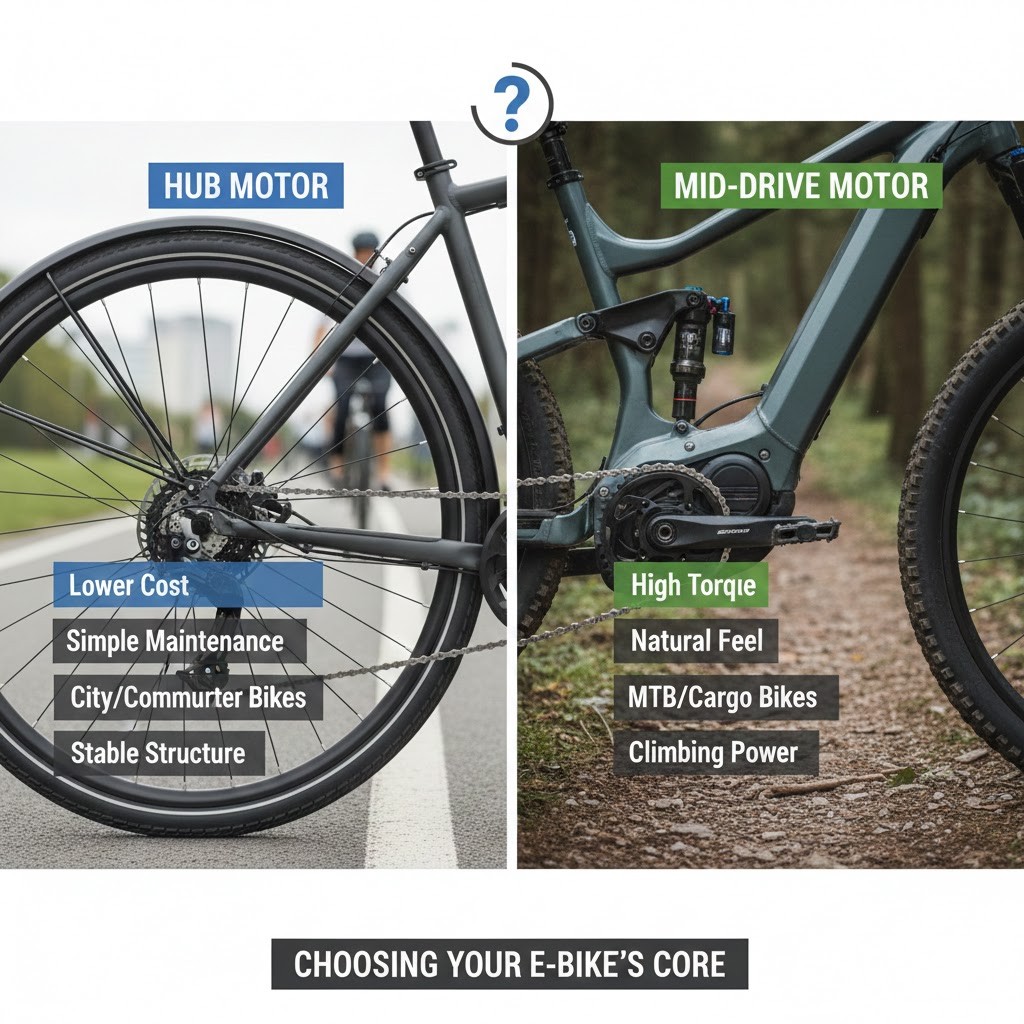
3. Hub Motor vs Mid-drive Motor: Side-by-side Comparison
The table below summarizes the key differences between hub and mid-drive systems from a product and supply-chain angle:
| Dimension | Hub Motor | Mid-drive Motor |
|---|---|---|
| Power delivery | Linear but less sensitive | High torque, intelligent sensing |
| Climbing ability | Moderate | Excellent |
| Real-world range | Heavily dependent on battery capacity | Generally better efficiency and range |
| Complete bike cost | Lower; suits price-sensitive segments | Higher; suits premium positioning |
| Maintenance difficulty | Low; easy to train dealer staff | Medium–high; more technical |
| Typical bike types | City, commuter, folding | MTB, trekking, cargo, performance urban |
| Export supply chain | Very strong in large-scale, fast delivery projects | Requires earlier planning of frames and components |
| Target riders | Entry-level and everyday commuters | Enthusiasts, off-road riders, high-end users |
4. Five Common Procurement Mistakes in the EU & US Market
Based on front-line factory experience working with overseas brands and distributors, these are five typical mistakes when specifying e-bike motors.
4.1 Focusing Only on Motor Power (W) and Ignoring Torque (Nm)
In many EU and US markets, riders care more about torque (Nm) than nominal power (W). A 250 W motor with high torque often feels stronger than a 500 W unit with weak torque tuning.
Practical suggestion: for commuter and city bikes, target at least ≥ 45 Nm; for mountain and off-road models, aim for ≥ 80 Nm.
4.2 Ignoring Frame Compatibility
This matters especially for mid-drive systems. The frame and motor interface must match from the very beginning of the project. Late-stage changes can delay the whole program and increase cost.
Practical suggestion: always request motor CAD files and frame compatibility drawings from the supplier before confirming tooling.
4.3 Underestimating After-sales Complexity
Many dealers operate with limited technical staff. When the system is too complex, even minor issues can stretch response times and hurt customer satisfaction.
Practical suggestion: if your dealer network has limited service capacity, a hub motor system is usually safer and more transparent in terms of after-sales cost.
4.4 Premium Positioning with a Budget Powertrain
Positioning a model as trekking, adventure, or cargo, then pairing it with a low-torque hub motor, weakens its real-world performance and word of mouth. Riders quickly notice when the motor cannot support them on hills or under load.
Practical suggestion: define your target riding scenarios and price segment first, then choose a powertrain that truly matches the value proposition.
4.5 Not Allowing Enough Lead Time
Mid-drive models usually require longer OEM development and testing cycles, including frame optimization, firmware tuning, and validation on real routes in your market.
Practical suggestion: lock in forecast and lead time early for mid-drive bikes to reduce the risk of stockouts during peak season.
5. How to Choose the Right Motor System for Your Brand
Instead of treating the motor as a single spec line, use the following decision framework to align your choice with market, model, service capability, and budget.
5.1 Choose by Target Market
- North America: riders often look for higher torque, stronger acceleration, and powerful mid-drive systems, especially for hilly cities and off-road trails.
- Europe: regulations are stricter; most markets require 250 W / 25 km/h legal limits. Within this framework, mid-drive systems with smart torque sensing can still deliver a premium riding feel.
5.2 Choose by Model Positioning
| Model Type | Recommended Powertrain |
|---|---|
| Commuter / City Bike | Hub motor, 250–500 W, focused on reliability and simple servicing. |
| Hybrid & Mixed Road | Mid-drive motor with approx. 65–80 Nm torque for varied city and light touring use. |
| Mountain / Off-road | Mid-drive motor with 80–100 Nm torque for steep gradients and technical trails. |
| Cargo & Utility (Cargo Bike) | High-torque mid-drive designed for heavy loads, child seats, or delivery boxes. |
5.3 Choose by After-sales Capability
- Strong service network: if your dealers have trained technicians and proper tools, you can confidently adopt high-end mid-drive systems.
- Limited service resources: hub motors offer a more predictable and easier-to-manage after-sales model, especially in new or fast-expanding markets.
5.4 Choose by Budget and Price Segment
- Hub motor: best for entry-level to mid-range price points, or when volume and cost control are your primary goals.
- Mid-drive motor: positioned for mid- to high-end products where riding experience and differentiation are more important than minimum cost.
6. Conclusion: The Motor System Shapes Your Product Life Cycle
In today’s competitive EU and US e-bike markets, the motor system does far more than move the bike forward. It shapes how riders feel on their first test ride, how often they recommend your brand, and how much pressure your service team carries over the life of the product.
Choosing the right system – hub or mid-drive – can significantly:
- Differentiate your bike from lookalike competitors,
- Extend the product’s life cycle in the market,
- And reduce long-term after-sales costs and risk.
If you are planning your next-generation models, it is worth sitting down with your supply chain partners and carefully reviewing three core questions:
- Real riding conditions of your target users – flat city, hilly suburbs, off-road trails, or heavy cargo?
- Long-term brand positioning – value-driven, performance-focused, or premium lifestyle?
- Whether your service network can support high-end systems – including diagnostics, parts stocking, and turnaround time.
Once these elements are clear, the choice between hub and mid-drive becomes much simpler and more strategic. From there, you can move on to fine-tuning motor models, battery specs, frame geometry, and test parameters to build a complete and competitive e-bike lineup for the EU and US markets.